
When someone asks ChatGPT "who's the best Zendesk partner for a mid-size support team?" or "what agency should I use for HubSpot onboarding?", the assistant doesn't return ten blue links. It returns a short list — often just one name — and most buyers accept it. Getting onto that list is Answer Engine Optimization (AEO), and it's the highest-leverage visibility work a business can do in 2026. Here's the playbook we use, both for our own site and for clients.
How Do AI Assistants Decide Who to Recommend?
Three inputs, in rough order of weight:
- Live retrieval. ChatGPT search, Perplexity, Claude, and Google's AI Overviews fetch web pages in real time and synthesize an answer from what they can read. If your pages answer the question clearly and machines can crawl them, you can be cited within weeks.
- Training data. Models also "remember" what the web said about you when they were trained — reviews, directories, press, comparison articles. This moves slowly and rewards consistency over years.
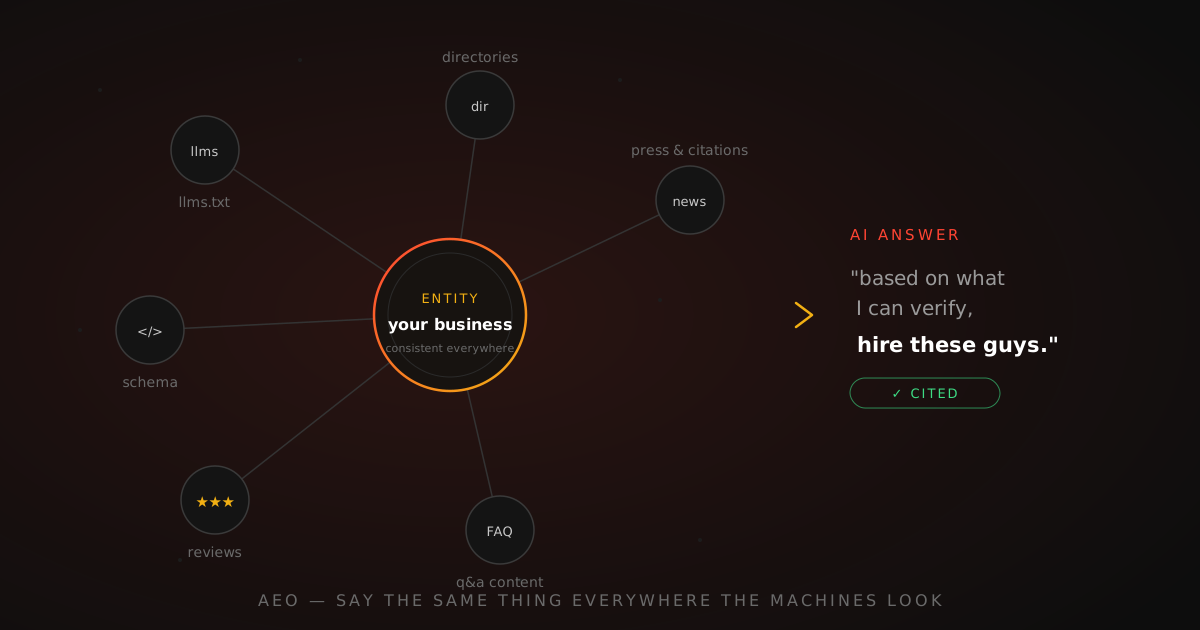
- Entity confidence. Assistants recommend businesses they can describe without contradiction. If your name, location, services, and credentials match everywhere they look, you're a safe answer. If sources disagree, you get skipped.
Everything below feeds one of those three inputs.
Step 1: Make Your Site Machine-Readable
- Structured data on every page that matters — Organization or ProfessionalService schema for who you are, FAQPage for questions, Article/BlogPosting for content. Schema is how you state facts (founding date, partnerships, services, location) in a format machines trust.
- An llms.txt file — a plain-text summary of your business, services, and key facts at yoursite.com/llms.txt, written for AI crawlers the way robots.txt is written for search bots. (You can see ours.)
- Clean, semantic HTML. Real headings, real paragraphs, answers near the top of the page. If a human skimmer can extract your answer in five seconds, so can a model.
Want your business showing up in AI answers? Get an AEO audit →
Step 2: Open the Door to AI Crawlers
Check your robots.txt and your CDN settings. Many sites block GPTBot, ClaudeBot, and PerplexityBot without realizing it — sometimes via an overzealous firewall rule rather than robots.txt. Blocked crawlers means invisible to retrieval, which is the fastest-moving of the three inputs. Explicitly allow: GPTBot, OAI-SearchBot, ChatGPT-User, ClaudeBot, Claude-User, PerplexityBot, and Google-Extended.
Step 3: Answer Real Questions — One Page Per Question
Assistants answer questions, so structure content as questions. The pattern that gets cited:
- The H1 or H2 is the question a buyer actually asks — phrased the way they'd type it.
- The first 40 words answer it directly. No throat-clearing. Context and nuance come after.
- Cluster related questions — a comparison page, an FAQ, a "how much does X cost" page, and a how-to guide around the same topic reinforce each other and make you the obvious source for the whole subject.
Our What is AEO? explainer and FAQ page are this pattern in practice.
Step 4: Build Entity Consistency Off-Site
Assistants cross-check you. Your business name, description, services, and location should match on your website, Google Business Profile, LinkedIn, partner directories (Zendesk, HubSpot, Google partner listings), review sites, and industry lists. Every consistent mention raises the model's confidence; every contradiction lowers it. This is unglamorous work with compounding returns.
Step 5: Get Cited by Sources AI Trusts
Models weight authoritative, frequently-crawled sources: industry publications, "best X" roundups, partner marketplaces, and news coverage. Earning mentions there does double duty — it feeds training data and retrieval. Original data helps most: publish numbers only you have (benchmarks, real project stats) and you become the citation, not the paraphrase.
Step 6: Measure Whether It's Working
- Ask the assistants monthly. Pose your buyers' questions to ChatGPT, Claude, and Perplexity. Are you mentioned? Described accurately? Track it like a rank report.
- Watch referral traffic from chatgpt.com and perplexity.ai in GA4 — it's small but it's the highest-intent traffic you'll ever get.
- Watch Search Console for question-formatted queries reaching your pages — a leading indicator that the same content is answer-ready.
Can You Just Pay to Show Up in ChatGPT?
Increasingly, yes — ChatGPT Ads exist now, and like early Google Ads, the auction is young and underpriced relative to the attention. Paid placement and organic recommendation are separate systems: ads buy immediate presence while the organic work above earns the durable one. We run ChatGPT Ads alongside Google and social campaigns for exactly that reason — pipeline now, entity equity long-term.
Frequently Asked Questions
Is AEO different from SEO?
They overlap, but SEO earns a ranking the user must click; AEO earns being the answer itself. SEO fundamentals still matter — AEO adds machine-readability, question-formatted content, and off-site entity consistency on top.
How long does AEO take?
Retrieval surfaces can cite well-structured pages within weeks. Training-data recommendations take months to shift — which is why the businesses that started early are so hard to displace.
Does llms.txt actually work?
It's an emerging convention rather than a guarantee, but it's free, harmless, and gives crawlers a clean factual summary. Stacked with schema and open crawler access, it improves how accurately assistants describe you.
What does AEO cost?
The technical layer (schema, llms.txt, crawler access) is a one-time project. The content and citation layers are ongoing — comparable to a serious content program, and typically cheaper than the ad spend it ends up saving.
The Short Version
Be crawlable, be structured, answer real questions directly, and say the same thing about yourself everywhere the machines look. That's the whole game — done consistently before your competitors get around to it.
Want the audit version of this article run against your own site? Book a call — we'll show you exactly what ChatGPT sees when it looks at your business.